Guide
Why foundations move in Boston
Boston is built on three very different kinds of ground, sometimes within the same few blocks. Which one is under your house decides what can go wrong and how it is put right.
Start with the ground
Filled land, glacial hills and ledge
Filled land
The flat parts of the city
A large share of level Boston was tidal marsh and mud until it was covered with sand and gravel in the nineteenth century. The Boston Groundwater Trust names the Fenway, Back Bay, the South End and the North End among the neighborhoods made this way.
Fill compresses under weight, so builders did not rest masonry houses on it. They drove wood piles through it to firmer material below.
Glacial hills
Drumlins of stony clay
Most of the city's hills are drumlins, smooth mounds left by the ice. The U.S. Geological Survey lists Bunker and Breeds Hills in Charlestown, Camp Hill in East Boston, Meeting House Hill and the paired hills at the heart of South Boston.
Their material, called till, is dense and carries a house well. Problems on a drumlin tend to come from the slope and from water running down it.
Ledge
Bedrock near the surface
South and west of downtown the rock comes up. The Survey describes Roxbury puddingstone, a hard natural concrete of pebbles, as cropping out widely in Roxbury and Dorchester.
A house that sits partly on ledge and partly on soil can settle unevenly, because the rock stays put and the soil does not.
Below the cellar floor
The layers a pier has to pass through
Away from the hills and the ledge, borings around Boston pass through much the same sequence, set out in a U.S. Geological Survey report on the area's soils. Fill comes first, often lying on old marsh deposits and peat. In places a thin bed of sand and gravel follows. Then comes a thick layer of Boston Blue Clay, stiffer near its top than lower down. Beneath the clay is very dense glacial till, and beneath that the bedrock, usually a slate-like rock called argillite.
Piers and piles work by reaching a layer that can take the load. How far down that layer lies changes from one street to the next, and it is one of the main things that sets the size of a repair.
Wood piles
Why the water table matters on filled land
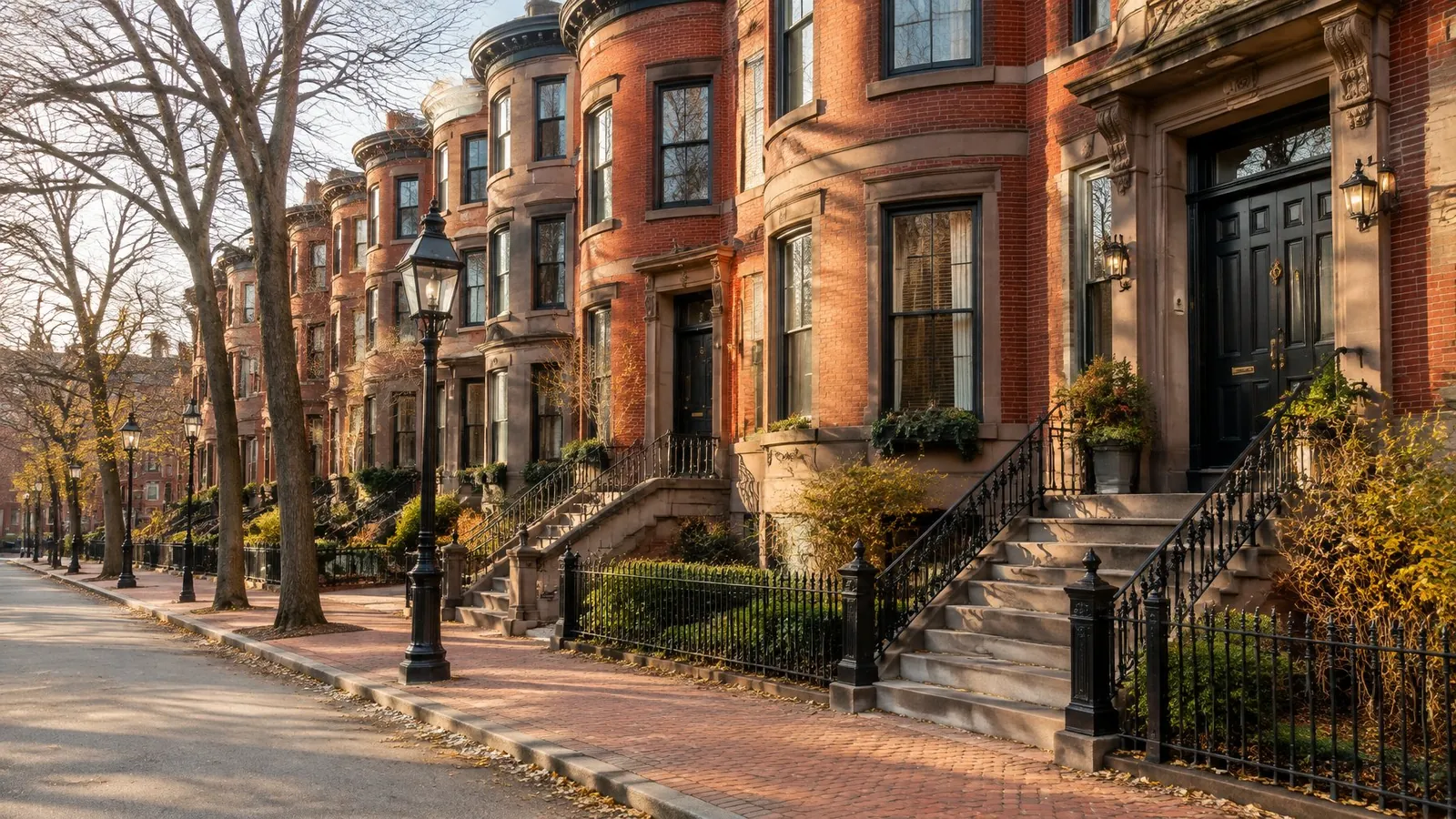
According to the Boston Groundwater Trust, row houses on filled land were set on wood piles capped with granite blocks, a way of building used from the 1800s into the early 1920s. Wood that stays under water does not rot. When groundwater falls below the pile tops, air reaches the wood, it decays, and the building above settles by different amounts in different places.
The Trust reads a network of observation wells across these districts so that falling water levels are noticed. If your home is a brick row house on flat ground near the Charles or the harbor, the page on Back Bay, the South End and Fenway explains how to look your building up.
Weather and age
Frost, soft mortar and water
Frost
The Massachusetts residential code sets the frost line at four feet. Basement walls go deeper than that. Porch posts, outside steps and small additions often do not, so they are the parts that lift and tilt first.
Lime mortar
Stone and brick basement walls were laid in lime mortar, which is soft and slowly washes out where water passes through. A wall can weaken this way without the ground moving at all.
Roof and yard water
Soil that is soaked again and again beside one stretch of wall settles more and pushes harder than dry soil. Much foundation trouble starts at a single bad downspout.
Questions about Boston ground
How do I find out whether my building stands on wood piles?
The Boston Groundwater Trust keeps an online Information Center where you can click a parcel and see the recorded foundation type, the level at which the piles were cut off where that is known, and whether the building has been underpinned. The Trust says the data is for reference and is not an engineering assessment.
Is my street on filled land?
A quick test is the city's Groundwater Conservation Overlay District map, which covers the filled areas where pile foundations are common. The Trust's maps page also links to maps of the original shoreline.
Foundation repair in Boston
Have a Boston foundation company take a look
Give the street, the kind of building and what has changed. The company settles a day to visit, and afterwards you receive its written account of the cause and what it would charge.
Ready to have it looked at?
Phone and say what you have seen. The firm on the other end is a Boston-area foundation repair company, independent of this website, and it can book a visit to your home.
Call (617) 555-0111You speak with an independent company, not with this website. See the referral disclosure.