Warning sign
Bowing or leaning basement walls
A basement wall holds back the ground. When the push from outside is more than the wall was built for, it starts to give, slowly at first.
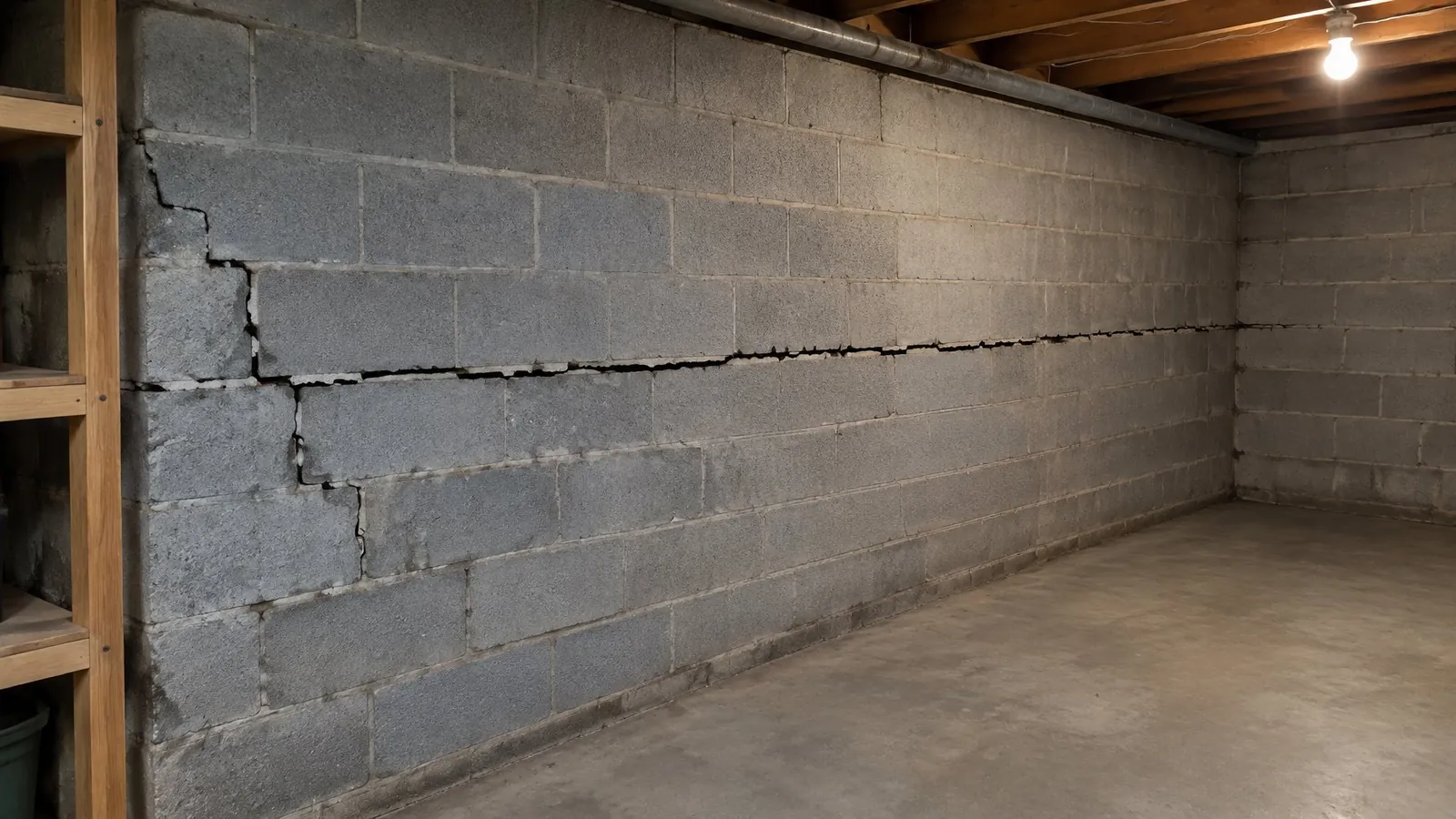
What it looks like
Signs that a wall is being pushed in
- A horizontal crack in a block wall, usually a few courses below ground level, with the wall bulging toward you along it.
- Stepped cracks at both ends of the same wall, where the bowed middle pulls away from the corners.
- The wall leaning in at the top, with a gap opening between the wall and the timber sill that sits on it.
- The bottom course sliding inward on the floor slab while the wall above stays upright.
- In a stone wall, a rounded belly partway up, sometimes hidden behind an old cement skim coat that has cracked in a web pattern.
Hold a long level or a weighted string against the wall from top to bottom. The gap at the middle or the base, measured in fractions of an inch, is the number an inspector will want.
Why it happens
What adds pressure to a basement wall
Water in the soil
Wet ground is heavier and presses harder. A downspout that empties at the foot of the wall, or a yard that drains toward the house, loads the same stretch of wall every time it rains.
Frost
Boston winters freeze the upper layer of soil. Ice forming in wet soil expands against the wall, and the cycle repeats each cold spell.
Weight beside the wall
A driveway, a parked truck, a new patio or a heap of stored soil next to the house adds load that the wall has to resist.
At the inspection
What a company measures
The inspector records how far the wall is out of plumb at several points, the width of each crack and whether the top of the wall is still held by the floor framing. Outside, they look at the slope of the ground, where roof water goes and what is built or parked along that side.
They will also ask how long you have known about it. A lean that an earlier owner braced thirty years ago is a different case from a bulge that appeared after last winter.
Possible repairs
How companies stabilize a bowing wall
Which of these suits a house depends on the wall material, how far it has moved and how much room there is outside. On tight Boston lots that last point often decides it.
Inside
Steel braces
Upright steel beams are set against the wall, fixed to the floor at the bottom and to the framing overhead. They need no digging outside, which suits row houses and narrow side yards.
Inside
Carbon fiber straps
Strips of carbon fiber are bonded to a block wall with epoxy to stop further bowing. They are used for small movements and do not straighten the wall.
Outside
Anchors and tiebacks
A rod runs from a plate on the inside of the wall to an anchor in undisturbed soil several feet away. The yard must have space for the anchor and belong to you.
Severe cases
Excavate and rebuild
The soil is dug away, the house is held on temporary supports and the wall is straightened or rebuilt with new drainage behind it.
Questions about bowing walls
Can a bowed wall be pushed back straight?
Sometimes, when the soil outside is dug away first. Many repairs are designed only to hold the wall where it is. Ask the company which of the two it is proposing and have the answer written into the contract.
Does a bowing wall get worse in winter?
Frost and spring thaw are when many owners first notice a change, because frozen wet soil pushes hardest. Measure the lean in the fall and again in spring to see whether it is seasonal.
The wall belongs partly to my neighbor's row house. What then?
A shared wall between two basements is not holding back soil, so true bowing there is unusual and should be looked at by an engineer. For front and rear walls, each owner is responsible for their own.
Foundation repair in Boston
Have a Boston foundation company take a look
Give the street, the kind of building and what has changed. The company settles a day to visit, and afterwards you receive its written account of the cause and what it would charge.
Ready to have it looked at?
Phone and say what you have seen. The firm on the other end is a Boston-area foundation repair company, independent of this website, and it can book a visit to your home.
Call (617) 555-0111You speak with an independent company, not with this website. See the referral disclosure.