Warning sign
A chimney, porch or steps pulling away from the house
Chimneys, porches and stoops are heavy, and many were built on small footings of their own. When those footings move, the gap shows where they meet the house.
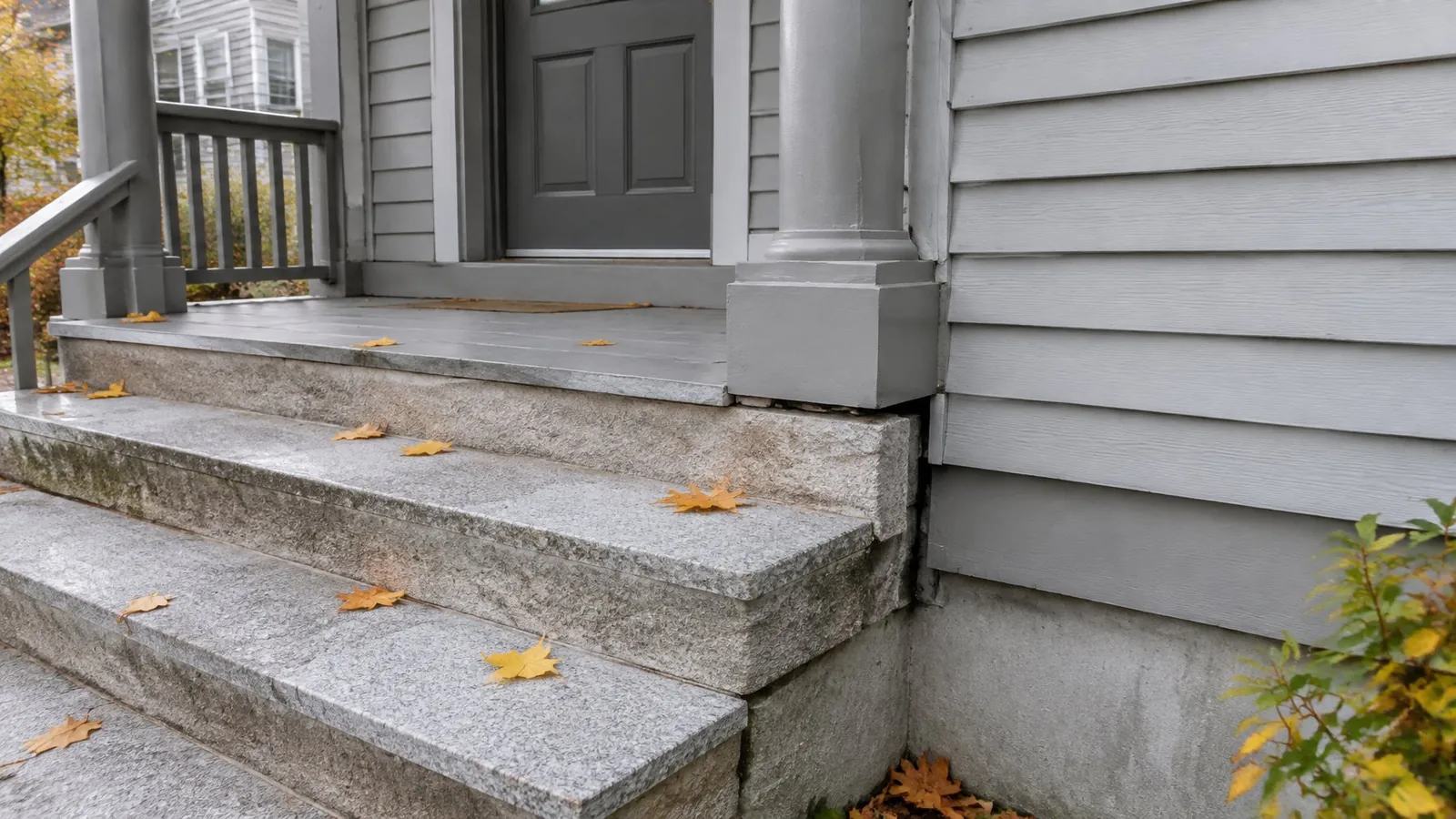
What it looks like
Where to look for separation
- Chimney: a gap between the brick and the siding that widens toward the roof, old caulk stretched or torn, flashing pulled out of its joint.
- Stacked porches: on a triple-decker, posts that no longer line up from floor to floor, a deck that slopes away from the door, railings that have opened at the house end.
- Front steps and stoops: a tilt to one side, a crack where the top step meets the threshold, a dark slot between the stoop and the foundation.
- Bulkhead and areaway walls: the low walls beside basement steps leaning into the stairwell.
Sight along the house wall from the corner. A chimney or porch that has rotated is easier to see from the side than from the front.

Why these parts move first
Shallow footings and frost
The main walls of a house go down to a basement floor well below the surface. A porch post, an outside chimney or a set of steps often stands on a pad only a foot or two deep. Ground at that depth freezes in a Boston winter, and wet soil lifts as it freezes and drops as it thaws.
After enough winters the pad no longer sits where it was built. Water makes it worse: a downspout that discharges at a porch corner keeps that soil soft and ready to heave.
Not always a footing
Other reasons for the same gap
Carpentry
Rot in the porch frame
Posts rot at the base and the beam that fastens a porch to the house can decay behind the trim. The porch sags although its footings are sound. That repair belongs to a carpenter or general contractor.
Masonry
A chimney worn out above the roof
Loose bricks and open joints at the top of a chimney come from weather. A mason rebuilds the upper part. The base may be perfectly stable.
Fill
Steps laid on loose ground
Precast or stone steps set on backfill beside a new foundation wall settle as the fill compacts. Resetting them on a proper base is a small job.
Inspection and repair
What a company checks and may propose
The inspector measures how far the chimney or porch is out of plumb, digs or probes beside the footing to see how deep it goes, and looks at how the structure is tied to the house. They also check where roof water lands.
For a chimney that is intact but leaning, a common proposal is to carry its footing on helical or push piers fixed with brackets. Porch posts may get new footings dug below the frost depth. Steps are usually lifted and reset. The methods guide describes piers in more detail.
Keep people from standing or parking under a chimney that leans and is dropping bricks, and have the flue checked before the fireplace or the heating appliance that uses it is run again.
Questions about chimneys, porches and steps
The porch boards and railings are rotten. Is that a foundation company's work?
No. Decking, railings and framing are carpentry. A foundation company is the right call when the posts or piers under the porch have sunk or tilted, or when the whole porch has moved away from the house.
There has been a small gap beside the chimney for as long as I remember. Should I act?
Measure it at the top and bottom, write down the figures and check again after a winter. A gap that does not change may only need sealing against rain. One that grows should be inspected.
Our triple-decker has three owners and the rear porches are leaning. Who decides?
Porches and their supports are normally common property in a condominium building, so the association decides and pays. Any one owner can ask for an inspection to get the facts in front of the others.
Foundation repair in Boston
Have a Boston foundation company take a look
Give the street, the kind of building and what has changed. The company settles a day to visit, and afterwards you receive its written account of the cause and what it would charge.
Ready to have it looked at?
Phone and say what you have seen. The firm on the other end is a Boston-area foundation repair company, independent of this website, and it can book a visit to your home.
Call (617) 555-0111You speak with an independent company, not with this website. See the referral disclosure.