Guide
Foundation repair methods, in plain words
A written proposal will name one or more of the methods below. This page says what each one does so you can follow the conversation. It does not say which your house needs. That takes an inspection.
The main methods
What each repair does and where it is used
| Method | How it works | Typical use |
|---|---|---|
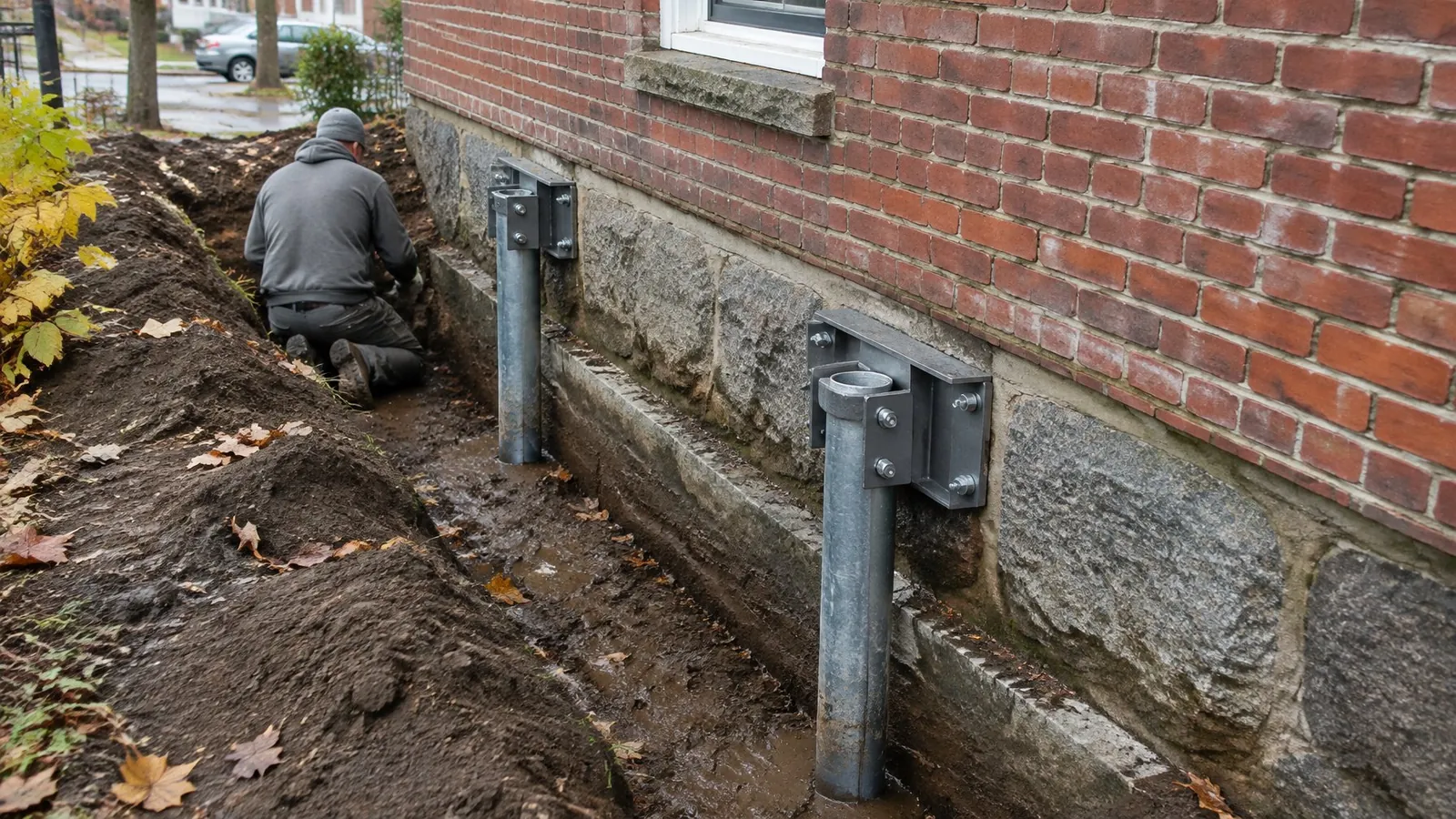
| Steel push piers | A hydraulic ram jacks sections of steel tube down beside the footing, bracing against the building's own weight, until the tube stops on something that will not yield. A bracket then cradles the footing. | An outer wall or corner that has sunk, where the building is heavy enough to act as the counterweight. A brick row house is. A light porch is not. |
| Helical piers | Picture a giant wood screw. Spiral blades are welded to a shaft and a motor winds it into the soil. Resistance on the gauge tells the installer when to stop. | Loads too light to drive a push pier: porch posts, stoops, chimneys, frame additions. Also handy in a low cellar. |
| Drilled piers and mini piles | A rig bores a narrow shaft down to bearing soil or rock. Reinforcing bar goes in, followed by grout or concrete. | Large loads and stubborn ground. The rig needs room, so a tight alley can rule it out. |
| Underpinning of wood piles | Crews tunnel beneath the wall in short stages, saw off the rotted head of each timber pile and build a steel and concrete post in its place. | Brick row houses on made land whose pile heads have been left dry. |
| Slab lifting | Coin-sized holes are drilled through the concrete and a setting foam or cement slurry is pumped beneath to float the slab upward. | Sunken cellar floors, garage aprons, walks and stoops. It does nothing for the walls that carry the house. |
| Wall braces, anchors and straps | Three ways to resist soil pressure: steel uprights wedged between floor and joists, threaded rods running out to plates buried in the yard, or carbon fiber bands glued to the blocks. | A cellar wall that bows or tips inward. |
| Posts, beams and sills | Rotted timber posts give way to concrete-filled steel columns on new pads, the girder is doubled or replaced, or decayed sill timber is cut out a section at a time. | Floors that dip toward the middle of the house. |
| Masonry repair and injection | Masons rake out and renew mortar, or relay loose stone and brick. In poured walls a resin is injected to close the crack. | Walls that have aged or cracked and have since stopped moving. |
Two different aims
Stop the movement, or raise the building?
Every structural repair has one of two goals. Stabilizing stops further movement and leaves the house at its present level. Lifting tries to recover some of what was lost. Lifting an old masonry or plaster house carries its own risks, since walls that settled slowly over decades do not always return without cracking.
A proposal should say which goal it has. If it promises a lift, it should say how much, measured where, and what happens if the house resists.
Before you sign
Questions to put to any company
- What do you think is moving, and which readings led you there?
- How deep are you assuming each pier goes, and what is the rate for every extra foot?
- Are you holding the building at today's level or trying to raise it? If raising, how far?
- Which engineer will stamp the drawings?
- Will your firm take out the permit in its own name?
- Which floors, pipes, walls or plantings get disturbed, and is restoring them in the price?
- Do I receive the installation log: depths, pressures, levels before and after?
- May I read the warranty before signing, and whose name is on it?
The answers belong in the written proposal. The guides on cost and choosing a company go further into the last few.
Foundation repair in Boston
Have a Boston foundation company take a look
Give the street, the kind of building and what has changed. The company settles a day to visit, and afterwards you receive its written account of the cause and what it would charge.
Ready to have it looked at?
Phone and say what you have seen. The firm on the other end is a Boston-area foundation repair company, independent of this website, and it can book a visit to your home.
Call (617) 555-0111You speak with an independent company, not with this website. See the referral disclosure.